
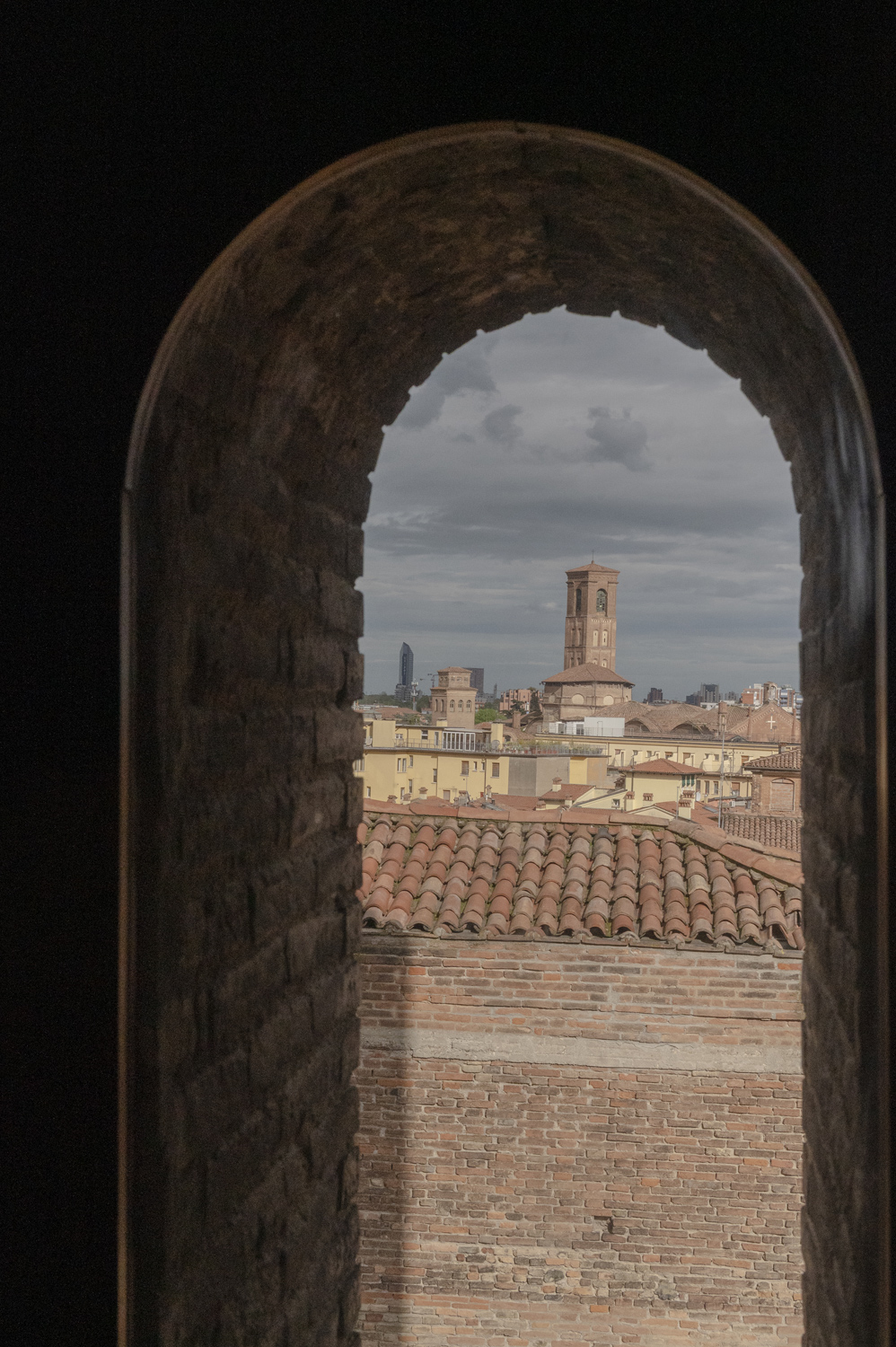
Between the 12th and 13th centuries, Bologna was dotted with towers: chronicles and 19th-century studies (Gozzadini) estimated up to 180, but more recent research cautiously narrows the figure to around 80–100 at the peak of their spread.
Today, just under twenty are still visible, with the famous Two Towers (Asinelli 97 m, Garisenda 47–48 m) serving as urban landmarks.
The towers originally fulfilled mixed purposes — both defensive and symbolic of noble prestige.
Their typical construction technique included a selenite base, deep foundations reinforced with piles, and muratura a sacco (double-layer brickwork with a rubble core) that thinned as it rose. This method is common among Bologna’s medieval towers and is now considered to be a part of Europe’s unique architectural heritage.
From Defense to Reuse
As early as the 13th century, many towers were lowered, incorporated, or demolished; in later centuries, some became prisons, civic offices, or residences.
The story of the Garisenda Tower — currently undergoing major structural stabilization — reminds us how fragile and evolving this heritage remains.
Torre Prendiparte – An Exemplary Case
Torre Prendiparte (also known as “Coronata”) was built in the 12th century by the Guelph family of the same name.
At about 60 meters tall, it is among the tallest surviving towers (second only to the Asinelli).
Between the 18th and 19th centuries, it had various uses: a seminary and the Curia’s prison. Inside, graffiti and inscriptions made by prisoners are still visible—documented by 19th-century tower studies and recalled in more recent research and publications.
Today, Prendiparte represents a virtuous example of architectural restoration and public enhancement—a historic residence that unites memory and hospitality. An inhabitable monument that allows visitors to experience firsthand the vertical sequence of its rooms—twelve floors connected by stairways—and to understand the relationship between medieval defensive architecture and modern reuse.